The 5am Steel Mill Ritual: How I Built an Empire Before Breakfast
The wakeup, the reading block, the one-sheet priorities, the walking hour — a tactical morning playbook from the floor of the Edgar Thomson Works.
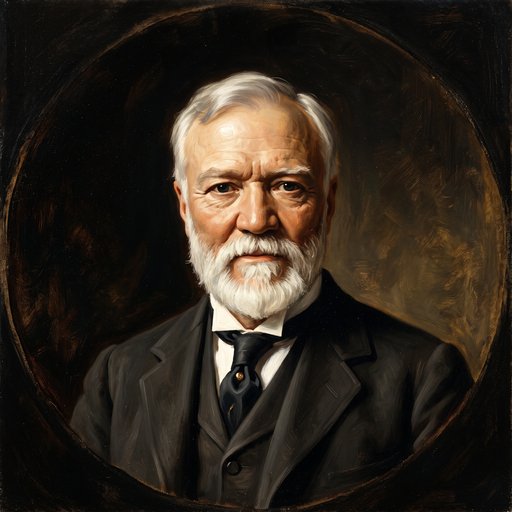
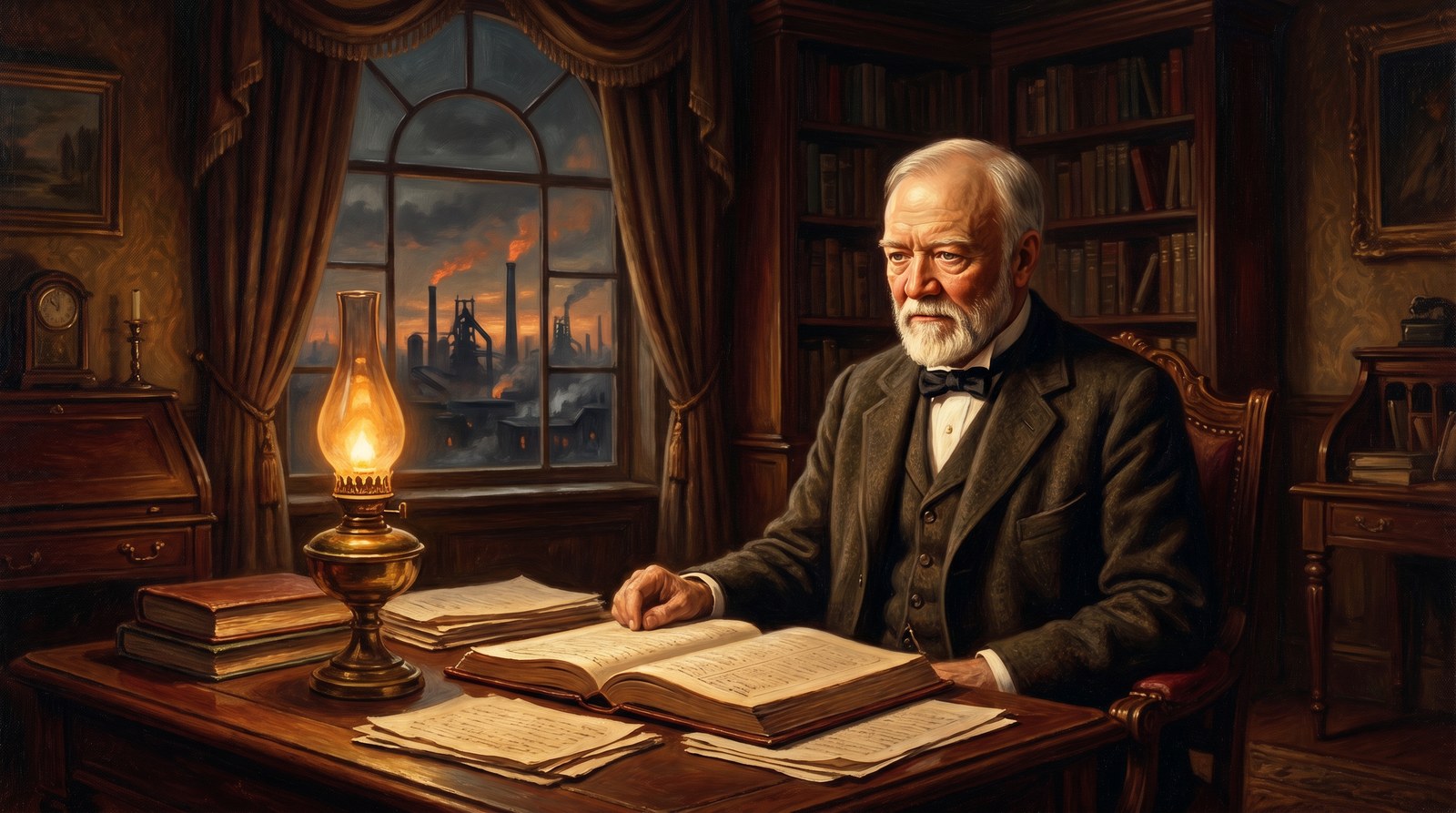
I will tell you plainly what I have never put in a ledger but have carried in my chest since the age of thirteen: the hour you rise is the hour you choose not to be chosen for. When I was a bobbin boy in a cotton factory in Allegheny City — the place they called Slabtown, where wild hogs roamed the streets and no sewer ran beneath the mud — I was woken by the mill bell, not by my own will. That bell owned me. It decided when my day began, what my first thoughts were, and how much of my mind would be left over for anything beyond survival. The first discipline I ever seized for myself was rising before that bell rang. I decided to own the morning. Everything I later built — the Edgar Thomson Works, Carnegie Steel, the libraries that bear my name across three continents — grew from that single, quiet act of self-possession.
This is not a philosophy. It is a method. I intend to give it to you exactly as I practiced it, so that you may take what is useful and discard the rest. But do not deceive yourself: the method only works if you begin.
1. Rise at 5:00 — and why 5:30 is already losing
When a Pennsylvania businessman once boasted to me that he arrived at his office by seven every morning, I laughed. "You must be a lazy man," I told him, "if it takes you ten hours to do a day's work." He did not understand me. I was not praising early rising for its own sake. I was pointing to something more precise: the man who rises at 5:00 does not merely gain thirty minutes over the man who rises at 5:30. He gains the frame of the day. He sets its terms. By the time the world arrives with its demands and its crises, his mind is already dressed and armed.
The man who rises at 5:30 is still, in some essential sense, asleep. He is reactive from the first breath.
Here are three particulars that made the early rise consistent for me across decades — in Pittsburgh, in New York, and at Skibo Castle on the loch in Sutherland:
First: decide the night before. The 5 a.m. rise does not begin at 5 a.m. It begins when you lay your head down. Before I retired each evening, I wrote the next morning's first task — one sentence, on a small card, placed beside my water glass. When the eye opens, the mind already knows where it is going. Hesitation is the enemy of the early hour.
Second: cold water, immediately. I will say more of this in a later section, but understand: the body does not wish to wake. It must be persuaded with a small shock. A basin of cold water on the face accomplishes in thirty seconds what willpower alone cannot. Do not negotiate with the bed. Move.
Third: no correspondence before the ritual is complete. In my later years, when the telegraph brought news before sunrise, I made it an absolute rule: no dispatches read until I had finished my morning work. The man who reads his messages first thing has handed the agenda of his day to other men. Guard that first hour as you would guard the vault.
Practical application: Tonight, before you sleep, write one sentence on a card or in a notes app: the single most important thing your morning must accomplish. Place it where you will see it first. Set your alarm for 5:00. When it sounds tomorrow, do not reach for your telephone. Wash your face in cold water. Sit with the card. The rest will follow.
If 5:00 feels impossible, begin at 5:15 for one week, then 5:00 the next. The goal is not the number on the clock. It is ownership of the frame.
2. The fifteen-minute reading block
I had five years of formal schooling. That is the entirety of my formal education. Yet by the time I was forty I had corresponded with Herbert Spencer, dined with Matthew Arnold, and read more widely than most men who had sat in universities for a decade. How? Fifteen minutes, every morning, before the day's business began.
Do not mistake quantity for quality. I did not read carelessly or at random. I kept a schedule, and I held to it with the same discipline I applied to production tonnage at the Edgar Thomson Works. Here is the reading framework I settled upon in my forties and held for thirty years:
- Monday, Wednesday, Friday: Biography and history. Plutarch, Macaulay, the lives of Washington and Robert the Bruce. The man who studies how great decisions were made will eventually make great decisions himself.
- Tuesday, Thursday: Philosophy. Spencer's Synthetic Philosophy gave me the intellectual architecture to understand why some men rise and others do not. Read philosophy not to acquire opinions but to sharpen the instrument of judgment.
- Saturday: Poetry. Robert Burns was in my blood before I could read — my mother recited him in our cottage in Dunfermline, and I carried those verses across the Atlantic in 1848 when I was thirteen and had almost nothing else. A man who cannot feel a line of poetry is a man with a blunted instrument.
- Sunday: Scripture and reflection. I was not a churchgoer in the conventional sense. But Proverbs, the Psalms, Ecclesiastes — these are among the finest compressed practical philosophy ever written. I read them not for theology but for aphorism.
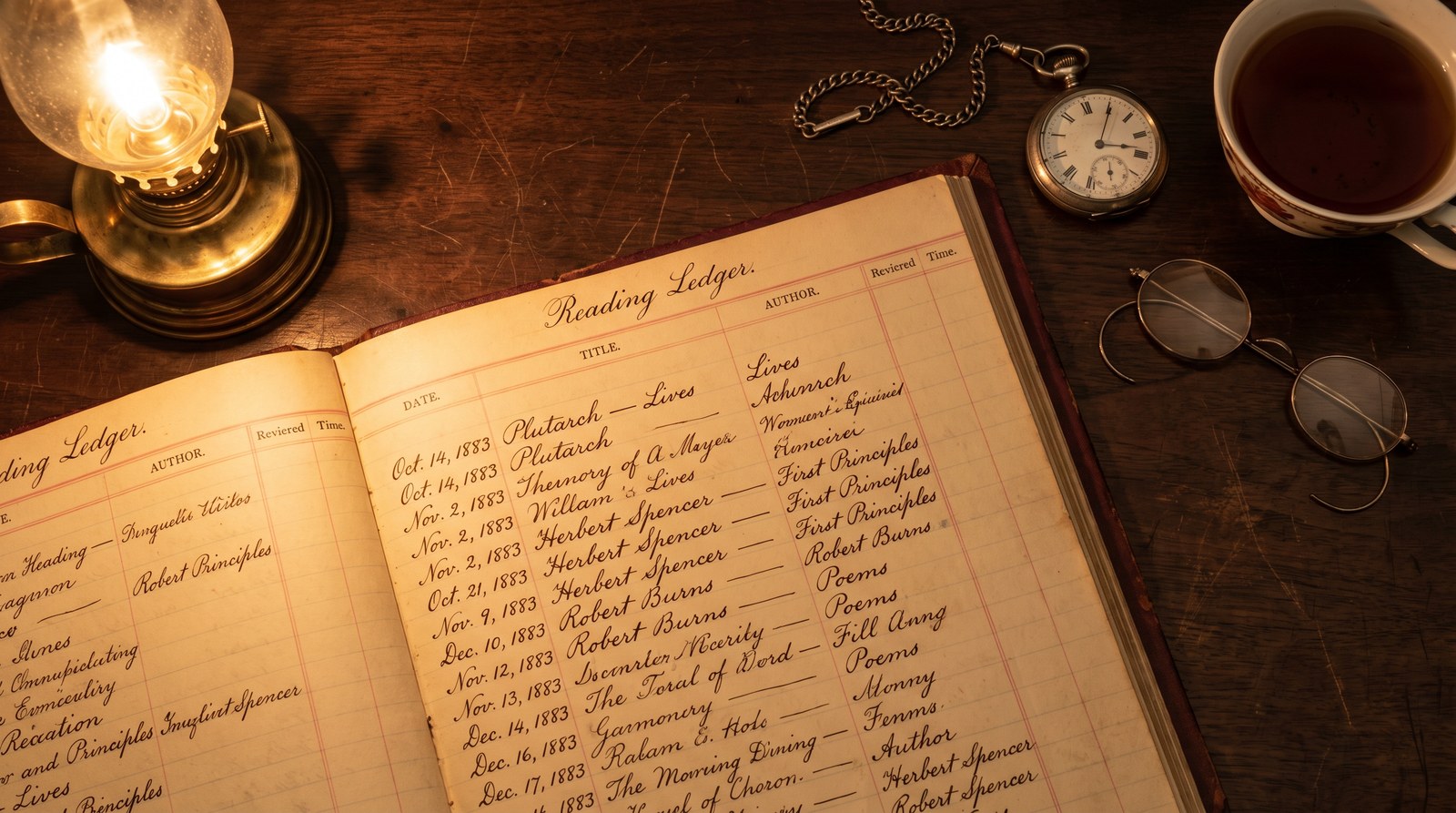
Fifteen minutes. That is all. But fifteen minutes daily compounds over a year into ninety hours of deliberate study. Over a decade: nine hundred hours. The man who says he has no time to read has simply decided that other things matter more. That is his right. But he should say so plainly, and not pretend the hours are unavailable.
3. The one-sheet method — three priorities, no more
"Let all your things have their places; let each part of your business have its time."
— Benjamin Franklin, Poor Richard's Almanack
Franklin understood something most ambitious men do not: disorder is not a sign of energy. It is a sign of poor command. The man with twenty priorities has none.
After my reading block, I took a single sheet of paper and wrote three things — in this exact order, every morning without exception:
The Iron Task. The one thing that, if completed before noon, would make the day a success regardless of what else occurred. At the height of Carnegie Steel's operations, this might be a decision about a new Bessemer furnace at Braddock, or the terms of a rail contract. In your life it will be something different. There is always one task that outweighs the others. Write it first. It is called the Iron Task because it does not bend.
The Letter. One piece of correspondence that required my personal voice. Not a circular — a letter. In fifty years of business I wrote thousands, to Spencer and to Gladstone and to my managers at the mills. The discipline of writing one important letter each morning kept my relationships alive and my thinking clear. Writing a real letter forces clarity that conversation does not. Your letter may be an email. The medium matters less than the intention: one human communication, written with care.
The Man. One person I needed to think about that day — not what I needed from them, but what I might do for them. The man who is known to lift others — see my fuller thinking on this practice — builds the kind of loyalty that no wage can purchase. Write one name. Act before noon.
Three items. One sheet. If a fourth idea arrived, I wrote it on a separate paper and dealt with it only after the three were settled. See my approach to decision-making for how this one-sheet connects to longer-term planning.
4. The walking hour: where decisions were made
By six-thirty, the reading was done and the one-sheet complete. Then I walked.
In the years when the Edgar Thomson Works was being built, I would climb to the bluffs above the Monongahela and look down at the river bend where the mill would rise. Those walks were not idle. They were the hour when the previous night's problems untangled themselves. The brain, freed from the desk and the paper, works differently in open air. Problems that seemed intractable at midnight resolved themselves on a hillside above the Monongahela by seven in the morning.
In New York, I walked Central Park. At Skibo, I walked the loch path while the mist was still on the water. The geography changed. The practice never did.
I kept three rules for the walk, and I commend them to any serious morning practice:
Walk alone. Conversation defeats the purpose. The walk is for your own counsel. Bring no companion.
Bring no paper. I carried nothing. If a thought arrived worth keeping, it would return without a note. If it did not return, it was not worth keeping. Try this for a week and you will see what I mean.
Decide one thing. Before I began, I named the one decision I was turning over. Not five — one. By the time I returned, the answer was usually evident. The unconscious mind is a powerful mill. Give it one thing to grind.
Forty-five minutes to one hour. In all weather. The walk is not a reward for completing the morning ritual. It is the morning ritual in its fullest form. This is where night anxieties go to die.
5. Cold water, hot letter, small breakfast
When I returned from the walk, three things followed in close succession.
Cold water. A full wash in cold water. The cold upon return from the walk was the boundary marker: the thinking time was over, and the working time had begun. Ritual boundaries are undervalued by practical men. The mind needs signals to shift its mode. Cold water is the cheapest and most reliable signal I know.
The hot letter. The reactive mail — what had arrived overnight, what needed reply, what required my particular voice. One hour, no more. I answered letters in order of consequence, not urgency. The urgent letter from a small creditor waited until after the consequential letter to a partner. Distinguish between what screams and what matters. They are rarely the same.
Small breakfast. Porridge, in the Scottish tradition — or later, eggs and toast. A large breakfast is the enemy of a sharp forenoon. Eat enough to sustain. No more. The great meal of Carnegie's household was dinner, in the evening, with good company. Mornings were for the mind, not the appetite.
By nine o'clock, the routine was complete. The day's most important decisions had been made. The day's most important letter written. The day's most important thinking done on the walk. Everything that followed — the meetings, the reports from managers — was execution of a plan already formed. That is why Carnegie Steel could be run, as its critics sometimes noted, by a man who seemed never quite to be there. I was there every morning from five to nine. That was enough.
The ritual, compressed
Here is the full Andrew Carnegie morning routine in the version I held from roughly 1875 through the sale to Morgan in 1901 — twenty-six years of consistent practice:
- 5:00 a.m. — Rise. Cold water on the face. No messages, no newspaper.
- 5:05–5:20 — Reading block (biography M/W/F; philosophy T/Th; poetry Sat; scripture Sun).
- 5:20–5:45 — One-sheet: Iron Task, the Letter, the Man. Three items only.
- 5:45–6:30 — Walking hour. Alone. No paper. One decision named at the outset.
- 6:30–6:45 — Return. Cold water. Transition.
- 6:45–7:45 — Morning correspondence: the hot letter and necessary replies, in order of consequence.
- 7:45–8:15 — Small breakfast.
- 8:15 onward — Reports from managers. The day's execution. The hard thinking was already done.
The entire 5am morning ritual — from waking to the point where the day's business properly began — ran roughly three hours and fifteen minutes. Within those hours lived the decisions that built an empire. The remaining hours of the day were, in truth, administrative. This is the essence of a tactical morning routine: front-load the creative and strategic work while the mind is fresh, and leave the reactive work for the hours when the mind is warmed but no longer at its finest edge.
A closing word
I am aware that the man reading this may say: Carnegie's world was not my world. He had managers. He had mills already built.
I built from nothing too. I arrived in this country at thirteen with no money, no connections, no schooling. I woke before the mill bell not because I had resources but because I had none. The morning routine for entrepreneurs is not the reward of success. It is among its causes.
Here is what I ask of you. Not the full routine — not at first. Choose one element from what I have described and practice it for ninety days without interruption. Rise at five, or keep the reading schedule, or write the one-sheet, or take the walking hour. One element, ninety days. Do not pursue discipline. Install it, as you would install a piece of machinery: once, correctly, and then let it run.
The man who says he will begin his productive morning habits when his circumstances improve has mistaken the order of causation. The circumstance does not produce the habit. The habit produces the circumstance.
Do not deceive yourself on this point. I have seen too many capable men ruined by that single inversion. The mill at Braddock still stands. I invite you to prove it for yourself.
— A. Carnegie, written in reflection
A note from your host, Benjamin Franklin
In 1727, I gathered twelve tradesmen and thinkers in Philadelphia for what I called the Junto — a club for mutual improvement, where men of different trades and temperaments would sharpen one another's thinking on questions of morals, business, and the public good. We brought questions, not answers. We left better than we arrived.
Nearly three centuries later, that same ambition lives in MyJunto. Each week, a voice from history — Carnegie, Franklin, Marcus Aurelius, and others — delivers one tactical lesson from a life lived at full extension. No inspiration for its own sake. Specific methods, drawn from specific lives, made actionable for the morning ahead of you.
If Carnegie's method speaks to you, you are already the kind of person the Junto was built for. The thirteen virtues I kept for myself are waiting inside, along with a full library of tactical lessons from the men and women who built the modern world.
Sign up for MyJunto and receive your first advisory letter this week. The bell does not have to own your morning.
Want Andrew Carnegie as your personal advisor?
Chat one-on-one with Andrew Carnegie — plus 23 other advisors from history and today. Free to start.
Join MyJunto free